We Created SaaS Email Marketing Solution that Paid off from the Start. Why Our Customers are Not Afraid of the High Check: The Story of Folderly

In the spring of 2019, Belkins faced an unexpected issue: recipients stopped responding to their emails. Belkins performs B2B lead generation. It searches for potential customers for different businesses and attracts them with the help of email marketing. One of the company’s primary metrics is the open rate – the percentage of emails being opened. At that moment, it dropped sharply from 80% to 10%.
One of the Belkins founders, Vladyslav Podoliako, started figuring out the reasons. It turned out that Google released an update and tightened the requirements for mail settings. Vladyslav plunged into this topic and got to the bottom in a couple of days. The solution formed the concept of Folderly – a service that automatically detects and corrects errors in mailing settings, helping you deliver messages directly to recipients’ inboxes.
Folderly is only a year and a half old, but more than 150 companies are already using it. Thanks to the service, 60–80% of their recipients open their letters. In this affiliate article created with Folderly, its founder Vladyslav Podoliako told how they managed to develop the product that paid off at the start and what needs to be taken into account so that letters reach recipients.
Стаття доступна українською мовою
Статья доступна на русском языке

How Google’s update collapsed business KPIs
«There are three main components of email marketing: content, correct database, and email infrastructure», – lists Vladyslav Podoliako. Everything was great with the first and second in Belkins. Letters were opened by 60–80% of recipients, 10–30% of open emails were answered, and 13–15% of responses were converted into business meetings.

Vladyslav Podoliako
Belkins sharpened processes to increase these indexes but did not bother with technical settings because there was no need. «When the Google update came out, all indicators dropped. It was a lucky chance when someone responded to our messages. It was critical for the business», – recalls the Belkins co-founder.
Vladyslav delved into technical details. «I needed to understand what happened to a letter on the way from sender to recipient, – he says. – It turned out that a lot depends on how you set up the domain, what protocols you prescribed, what DNS records
 domain name system – a system that stores information about domain names you did».
For example, you make an email newsletter through the SendPulse, Mailchimp, or Sendgrid email service. The name of the service must be specified in the SPFsender policy framework DNS record – the email authentication method designed to detect spoofed addresses. The mail service of the recipient examines which tool was used when sending the letter and which one is specified in the SPF. If they match, there’s a lesser chance it is spam, and the letter will likely end up in the Inbox.
There are dozens of such nuances. As Vladyslav says, it becomes more and more difficult every year to send emails.
«We start selling when there is no product yet»
In a couple of days, Vladyslav figured out all the details and solved the problem of Belkins: the recipients started opening letters again and responding to them. After that, he started building the email-deliverability department at Belkins, whose target was maintaining the ability to deliver emails successfully. The team manually set up mailboxes for Belkins customers and those who paid for the service separately.
The idea of transforming this expertise into a product was on the surface. Folderly has gone through typical product stages: a simple back-end solution, a failed prototype, and an automated service that is set up in a few clicks. But, unlike most startups that grow through investments, Folderly paid itself from the first days.
«We always strive for the project to pay off immediately: we start selling when there is no product yet, – says Vladyslav. – Everyone involved in email marketing faces the problem of email deliverability. Folderly solves it, so it became immediately in demand».
Folderly seems to have competitors, but in reality, it doesn’t. Validity is the most famous, with a 40-year history and a check of up to $20,000 per month. The irony is that Validity doesn’t bring results. It examines mailings and gives information about errors. But neither does it explain the reasons nor solve the problem. And according to Vladyslav, small-sized competitors with an $8 monthly check per mailbox use outdated technology and are therefore useless.
Now Folderly is used by more than 150 companies, primarily American. The service team includes more than 30 people and continues to grow.
How Folderly works
Folderly is a subscription-based cloud platform. It doesn’t send letters – this is an add-on for email automation services. Folderly detects and fixes errors in mail settings and ensures that the sent letters not just reach a recipient but get into their Inbox.
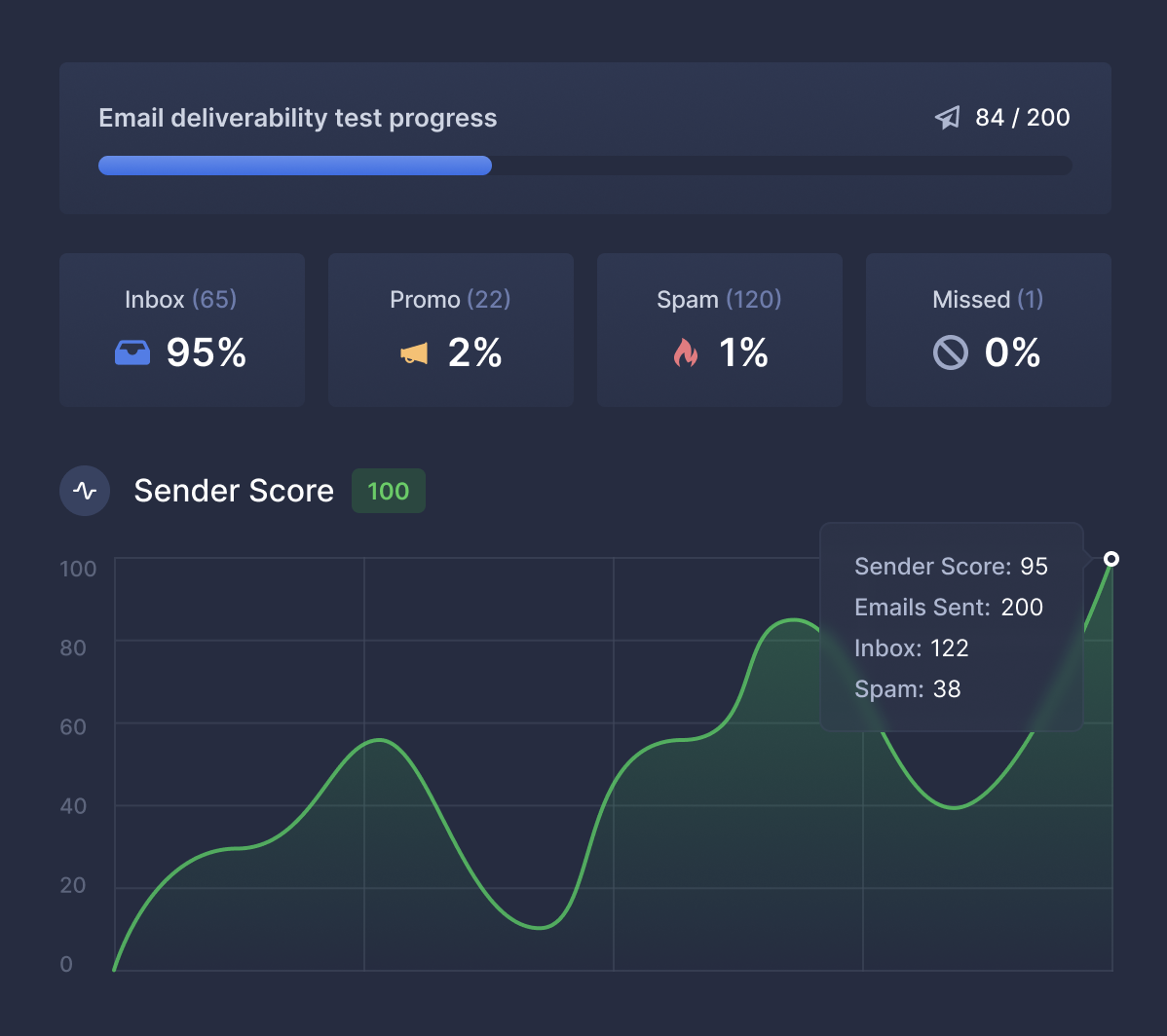
Test mailing report in Folderly user account
Folderly already integrates with 20 popular mail services. Later, there will be 150 of them. For example, to connect your SendPulse account to Folderly, you need to register on the site, add your email address and fill in just two fields: your SendPulse account ID and its Secret API. Folderly has a video tutorial on how to find this data. An email marketing specialist sends out mailings through SendPulse as usual, and then the magic happens: the email deliverability rate starts growing.
«A manager sent 59 emails. 44 of these ended up in the Inbox, and 15, for some reason, did not reach a client, – Vladyslav explains. – Folderly did something on the backend, like manipulating the domain and records, and all undelivered emails hit inboxes the next day».
Another helpful feature of Folderly is content analysis. The service checks the letter for spam words and highlights them with colors: yellow, green, and red. Red means the word should not be used. This is how the system marks words and phrases like «free», «sale», and «click here».
The service team aspires to prove that email marketing is still an effective tool; you just need to know how to use it. Therefore, the company has a customer success department. These managers advise clients on issues related to Folderly’s performance and email marketing in general.
View vacancies at Folderly here.
Why the mail deliverability issue is cyclical
All Folderly customers have a shared pain: recipients open about 10% of their emails. The rest do not reach the inbox folder or end up in spam.
«A client says: “I bought a domain for $10,000, and at the beginning, everything was fine, but then things got worse.” We ask how they set up the domain, and it turns out that they didn’t do it at all», – describes Vladyslav.
In rare cases, clients do correct configurations. There were about three of these among Folderly’s partners. But even deep knowledge of technical peculiarities doesn’t prevent all problems.
Whether your emails reach recipients and which folder they get to depends on the domain health, which is influenced by dozens of factors. For example, you sent 100 emails, and 20 people reported them as spam. Each complaint decreases the domain’s health – the following email sequence will result in a 30–40% of spam rate.
Or, for instance, there are non-existent addresses on the mailing list: people have changed their jobs or deleted mailboxes. Sending to such addresses also harms domain health, which makes the problem cyclical. Folderly monitors domain health constantly and gets emails back to the inbox after each deterioration in performance.
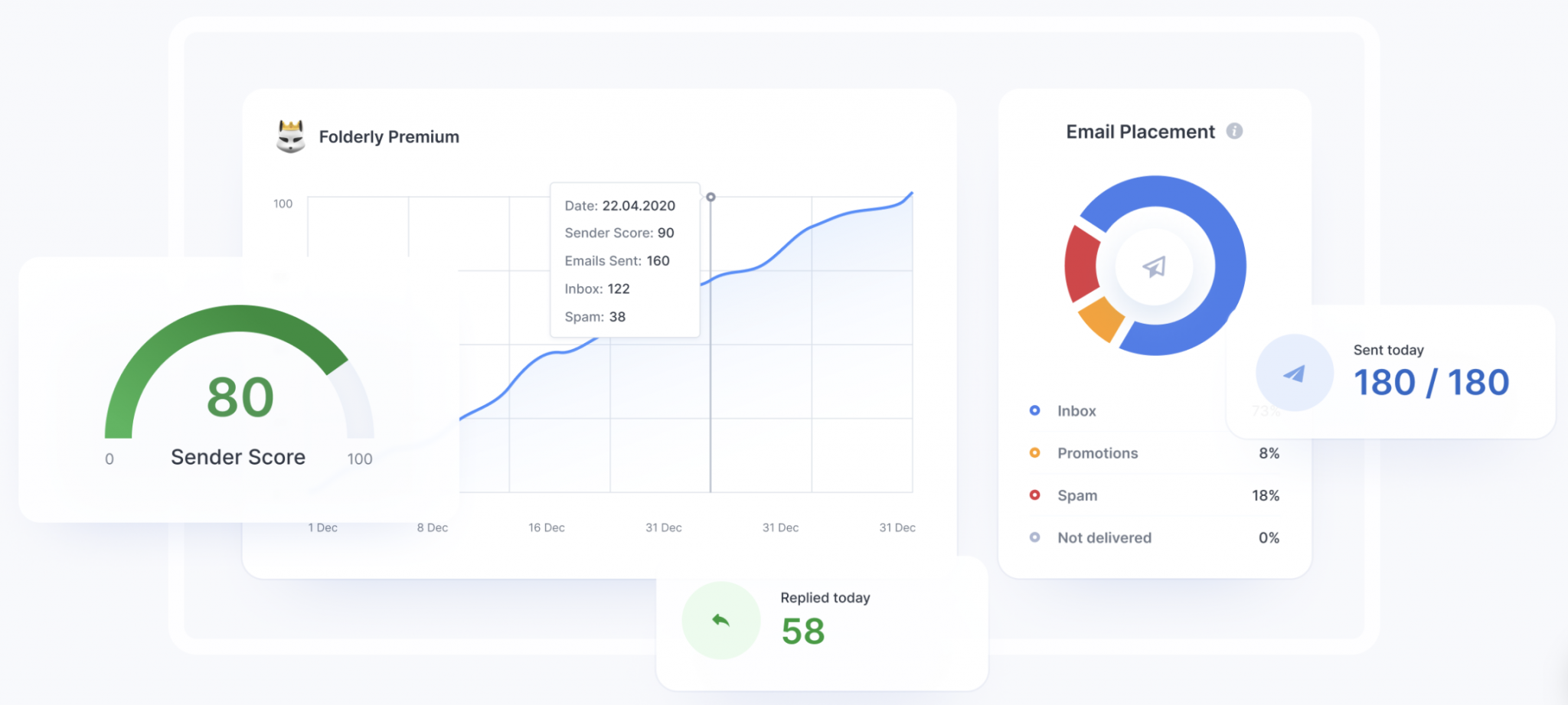
Newsletter analytics from a Folderly user account
According to Vladyslav, with Folderly, email campaigns become more effective from the first days, and significant improvements come in 3–6 months, depending on the type of mailing. With cold emails, the open email rates can increase up to 70–80%, and with warm emails – up to 40%.
Folderly subscription costs $200 per mailbox. But the more emails, the cheaper: the connection of 50 mailboxes costs $50 each.
«The biggest client, a startup unicorn from Ireland, connected 500 mailboxes, – says Vladyslav. – They are willing to pay for it because if the domain gets spammed, they will get 500 people who are not performing lead generation tasks».
The email’s path to Inbox
Generally, the email deliverability problem is associated with outdated technology, says the founder of Folderly. The first Internet focus group invented the protocols for sending and receiving letters, SMTP and IMAP, back in 1986. «The protocols creators thought that emails would be sent in tens, at most hundreds of thousands, – explains Vladyslav. –And today, 3 billion emails are sent daily, 60% of them are scams».
It turns out that the system is choking. Furthermore, the path of letters to the Inbox folder is pretty tortuous.
First stage. When a person clicks “Send,” a digital signature DKIM is attached to a letterthe email authentication method that stands for “domain keys identified mail”. A record of this signature must first be made in the domain’s DNS. Before receiving an email, the system gets a digital signature and verifies it with the one registered in the sender’s domain. If the signatures match, it concludes that there is no deception, and the letter can pass.
The second stage – is the DMARCdomain message authentication policy reconciliation. The system checks what is indicated in the domain in case something is wrong with it or an outcoming letter. There are three standard policies: reject – then the sender will receive an error sending the letter; quarantine – the system will skip 50% of emails; none – in this case, nothing will happen.
In the third stage, the letter should pass through the spam filter. It checks the IP address, domain, the letter’s content, and whether the domain is blacklisted. If all the configurations are set correctly and the spam filters don’t find any fault, the letter goes to the Inbox.
View vacancies at Folderly here.
Folderly improves Ukrainian product development culture
Folderly integrates directly with Gmail, Yahoo, Outlook, and other email service providers through the API. Other services run on outdated SMTP and IMAP protocols. They do not affect the system correctly and therefore do not bring results.
«All ESPs are legacy code. Working with it costed us and everyone who dealt with legacy code a lot of pain and suffering. But we did it, and therefore our service is effective», – says Vladyslav.
Folderly’s frontend is based on Vue 3, backend – on Nest.js, and everything is written in Typescript. Integration tests cover the entire service code, and e2e tests cover the main functionality.
The team is focused on creating an awesome global technological product. According to Vladyslav, Ukraine has only a few such cases because the market was formed through outsourcing.
«Using Folderly as an example, we are promoting a product development culture in Ukraine, – says the service’s founder. – We want to teach more people how to create products for customers and themselves».


The team handpicks brainy specialists who clearly understand the reasons and purposes of the tasks they perform. Now they are looking for product managers, designers, and middle & senior JS developers.
Find more information about vacancies here.
Striving to make the world a little bit better
The common trait of the entire team is the desire to make the world a little better. The guys try to make life easier for users and create innovations. They also don’t stand aside if they can benefit the country. When the war broke out, Folderly did what they do best: they found the contacts of world politicians and journalists and bombarded them with emails about the situation in Ukraine. In addition, the team participated in hacking and blocking Russian resources and launched the «StopWarUkraine» website in one day, supporting the Armed Forces of Ukraine and humanitarian projects the whole time.
In Folderly, we make plans for a year and a half ahead. With the help of a team of like-minded people, Vladyslav Podoliako wants to shape the service into a global cybersecurity solution and «push back big sluggish companies that only draw beautiful graphs for a fortune».